On this page
- How laser tattoo removal works
- Laser types: Q-switched Nd:YAG vs picosecond
- How many sessions you will need
- Colours that are hardest to remove
- Does tattoo removal hurt?
- Scarring and pigment risks for darker skin
- Removal creams, salt and other myths
- Aesthetic clinics vs tattoo studios: the Malaysian rules
- What to ask at a consultation
- Fading a tattoo for a cover-up
- Tattoo removal prices in Malaysia
- Tattoo removal clinics by city
- Is laser tattoo removal right for you?
- Frequently asked questions
Quick answer
Tattoo removal in Malaysia means laser treatment at a doctor-led aesthetic clinic. Most tattoos need 5 to 12 sessions, spaced 6 to 8 weeks apart, so plan on a year or more. Published prices start from about RM288 per session for a small piece. Black ink fades best. Full clearance is likely but never guaranteed.
Tattoo removal in Malaysia has grown into a busy market, and almost every guide you find online comes from a clinic selling its own laser. This guide is different. We compare laser types, session counts, prices and risks across many clinics. We also explain the Ministry of Health (MOH) rules, so you know who may legally point a laser at your skin. First, though, a word on expectations: removal takes time, it costs more than the tattoo did, and some inks never fully leave.
People remove tattoos for many reasons. Some want a fresh start after a break-up. Others need clear skin for a job, a uniformed service or a wedding. Many Muslims also seek removal for religious reasons. Whatever your reason, the steps below apply.
How laser tattoo removal works
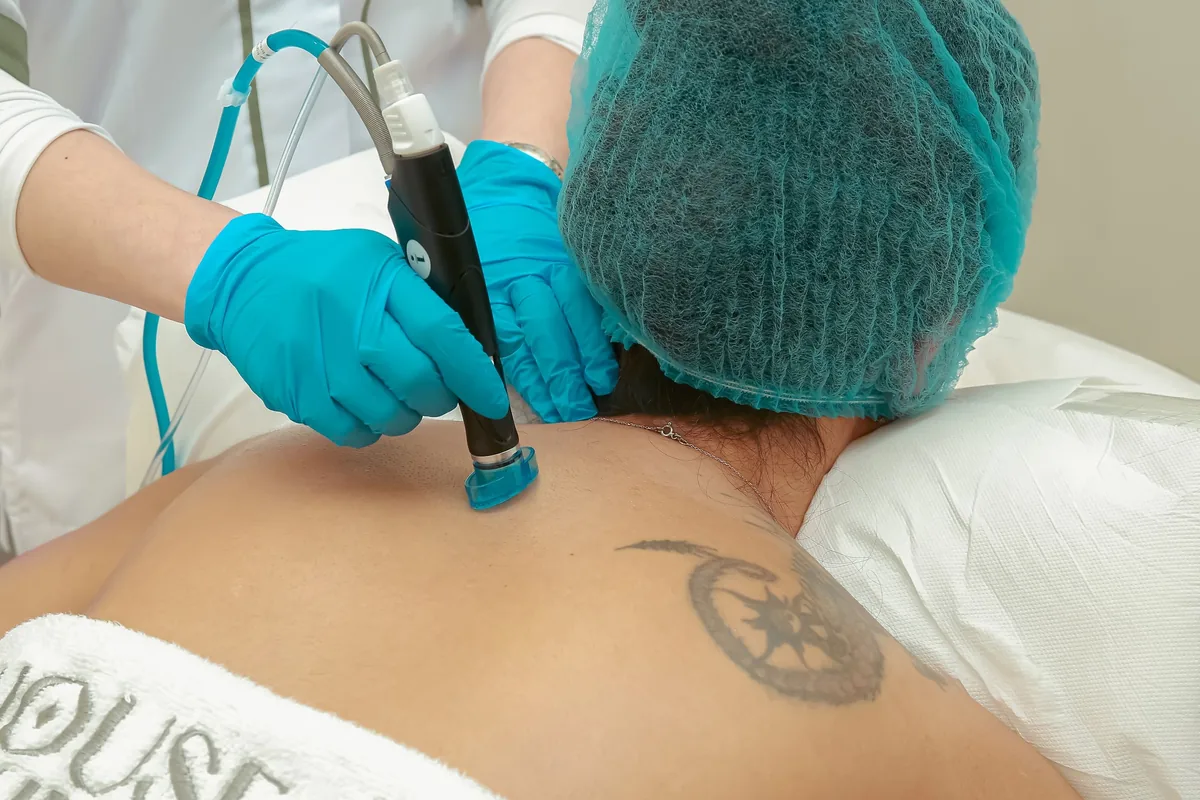
A tattoo sits in the dermis, the layer under the top skin. The ink particles are too large for your body to clear, so they stay put for life. A laser sends very short, very strong pulses of light into the skin. The ink soaks up that light and breaks into smaller fragments. Then your immune system carries those fragments away over the following weeks.
Kaiteki Aesthetic Clinic puts it simply: the laser "does not remove ink directly; it makes the particles small enough for the body to clear over the weeks that follow". That is why you see fading between visits, not on the day. It is also why clinics space sessions weeks apart. Your body needs that time to do its share of the work.
Different ink colours absorb different wavelengths of light. As a result, a clinic needs the right wavelength for each colour. The American Academy of Dermatology (AAD) warns that "a single laser cannot remove all ink colors", which matters when you compare clinics with one machine against clinics with several.
Laser types: Q-switched Nd:YAG vs picosecond
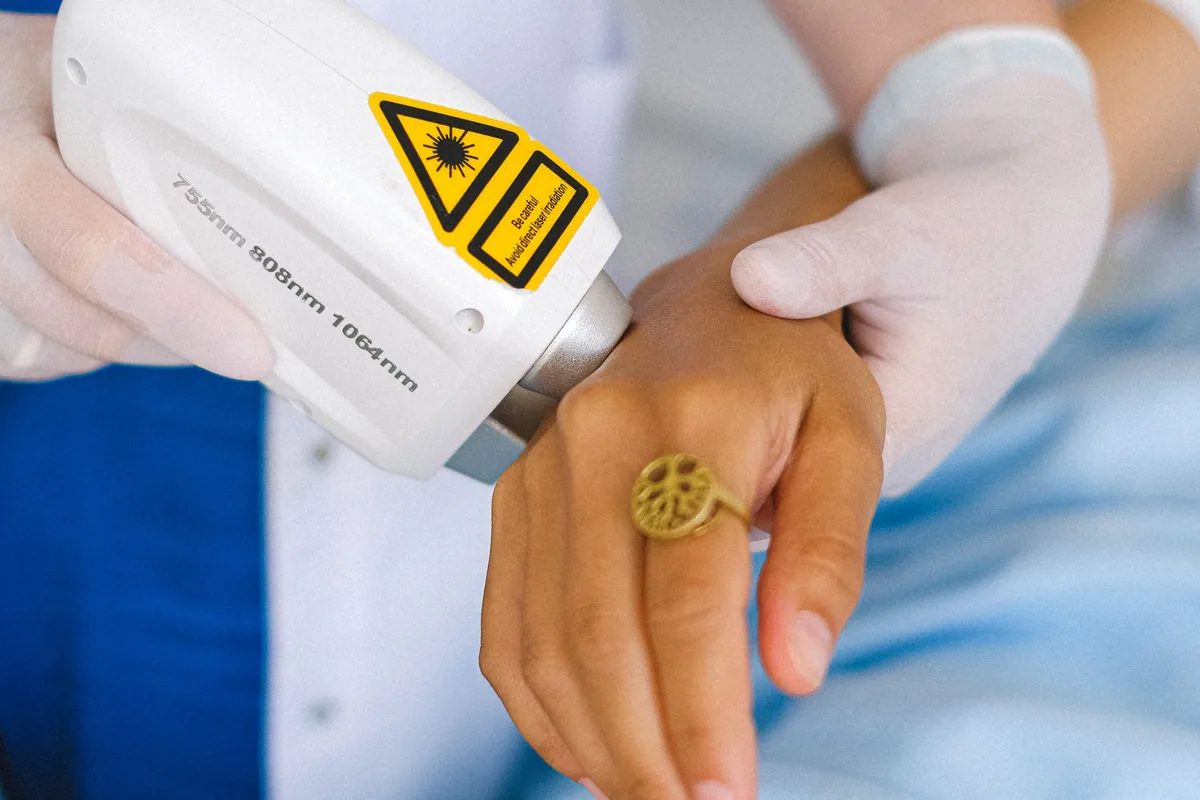
Two families of laser do most tattoo removal in Malaysia. Q-switched lasers fire pulses lasting nanoseconds (billionths of a second). Picosecond lasers, often sold as "pico laser", fire pulses about a thousand times shorter. Q-switched pulses work mainly through heat. Pico pulses add a pressure wave, which clinics call a photoacoustic effect.
Clinics often claim pico needs fewer sessions. For example, Premier Clinic says a small professional tattoo took about 10 to 20 sessions with Q-switched lasers, against 4 to 6 with pico. However, that is a marketing claim, and the published evidence is mixed. In practice, the skill of the doctor and the choice of wavelength matter as much as the brand of machine.
| Feature | Q-switched Nd:YAG | Picosecond ("pico") |
|---|---|---|
| Pulse length | Nanoseconds | Picoseconds (about 1,000 times shorter) |
| Main effect on ink | Mostly heat (photothermal) | Pressure wave plus heat (photoacoustic) |
| Wavelengths named by clinics | 1064nm and 532nm | 1064nm, 532nm and 755nm (alexandrite) |
| Devices named on Malaysian clinic sites | Cynosure RevLite, MedLite C6 (Sliq Clinic); Q-switched mode on Fotona PQX (Kaiteki) | PicoSure (Kaiteki), Fotona StarWalker PQX (Sliq, CLEO, Kaiteki), Discovery Pico (Sheen, Nexus) |
| Sessions | The Kirby-Desai scale was built on Q-switched lasers: typically 5–12+ | Clinics claim fewer; independent evidence is mixed |
| Darker skin | Nexus Clinic says it carries a higher risk of pigment change on darker skin | Clinics market it as gentler on darker skin, but pigment change can still happen |
| Published price per session | Sliq Clinic quotes RM400–RM800 across its devices | From RM288 (CLEO) to RM2,500 for large pieces (Nexus) |
Pico laser in Malaysia: skin treatment or tattoo removal?
You may also see the term "pico laser Malaysia" used for skin treatments such as melasma and pigmentation. The same machines do both jobs. So when a clinic advertises pico, ask whether it uses the device for tattoos and which wavelengths it has.
How many sessions you will need
DermNet, the New Zealand dermatology resource, says most tattoos need 5 to 12 treatments at 6 to 8-week intervals. It adds that complete clearance is not always possible. Malaysian clinics quote similar figures. For instance, Her Clinic says 4 to 8, GLOJAS says 5 to 8, A.M Clinic says 6 to 10 or more, and Sliq Clinic says 8 to 10 for Asian skin.
O2 Klinik gives the most useful breakdown by size, shown below. Note that these are a clinic's own estimates, not promises.
| Tattoo size | Sessions |
|---|---|
| Extra small (smaller than a 50 sen coin) | 3–5 |
| Small (palm-sized or smaller) | 4–6 |
| Medium (half an A4 sheet) | 6–8 |
| Large (full A4 sheet) | 8–12 |
| Extra large (sleeve or back) | 12–15+ |
Most clinics space sessions 6 to 8 weeks apart. A few, such as Sliq Clinic and dermatologist Dr Peter Ch'ng, mention about a month. Either way, eight sessions at eight-week gaps add up to more than a year. For most people, tattoo removal in Malaysia becomes a long project, so start well before any deadline such as a job interview or wedding. Hands, ankles and feet clear ink more slowly, so Kaiteki uses longer gaps there.
The Kirby-Desai scale: why your tattoo differs from your friend's
Dermatologists use the Kirby-Desai scale to predict how many sessions a tattoo will need. Kirby and colleagues published it in 2009 in the Journal of Clinical and Aesthetic Dermatology. In a study of 100 patients, the score tracked closely with the actual number of sessions. The scale adds up points for six factors:
- Skin type (Fitzpatrick I to VI). Darker skin scores higher, because the risk of light patches is greater and doctors must use gentler settings.
- Location. The head, neck and upper body score lower. Hands, fingers, ankles and feet score higher, because they clear ink more slowly.
- Colour. Black only is easiest. Multiple colours score highest.
- Amount of ink. Dense, heavily saturated work needs more sessions.
- Scarring or skin change. Scar tissue from the original tattoo slows clearance.
- Layering. A cover-up over an older tattoo means two layers of ink to break down.
The paper assumed Q-switched Nd:YAG or alexandrite lasers with 6 to 8 weeks between visits. So treat any score as a rough guide, especially with newer pico machines.
Colours that are hardest to remove
Black ink absorbs the most light, so it fades best. Green, yellow and pastels are much harder. Nexus Clinic, for example, says professional black takes 4 to 8 sessions, green 7 to 12 and yellow 8 to 14 or more. It also calls red, orange and yellow "historically the hardest colours". Kaiteki adds that yellows, pastels and cosmetic pigments are less predictable.
Some inks also darken under the laser. DermNet explains that brown ink can turn black when ferric oxide becomes ferrous oxide. Similarly, A.M Clinic warns that cosmetic and light pigments "may darken after laser exposure". This matters for faded brow tattoos and "sulam" work, which are common in Malaysia. In that case, ask for a small test spot first. Before you commit to tattoo removal in Malaysia, ask the clinic which of your colours it expects to clear and which may remain.
DermNet notes that red ink causes the most allergic reactions to tattoos. If your red tattoo is itchy or raised, see a dermatologist before any laser work, because treating an allergic tattoo needs care.
Does tattoo removal hurt?
Pain is a common worry about tattoo removal in Malaysia, and the honest answer is that it hurts, though most people manage it. Her Clinic compares each pulse to a rubber band snapping on the skin. Clinics usually apply numbing cream beforehand and use cooling during the session. A small tattoo takes only a few minutes of laser time. Afterwards, expect redness, swelling and sometimes blisters or crusts for several days. Her Clinic says redness and swelling usually settle within a week.
Pain follows the same pattern as getting tattooed. Bony, thin-skinned spots such as ankles, ribs and fingers tend to sting more. Our tattoo pain chart shows which body areas hurt most, and the same map holds roughly true for laser.
Scarring and pigment risks for darker skin
Many Malaysians have Fitzpatrick skin types IV to VI, meaning medium to deep skin that tans easily. For these skin types, the main risks are pigment changes rather than scars. Melanin in your skin competes with the tattoo ink for laser energy. This is the biggest skin-related risk of tattoo removal in Malaysia. The treated area can turn lighter (hypopigmentation) or darker (post-inflammatory hyperpigmentation, often called PIH).
The AAD says these light or dark spots "tend to disappear within 6 to 12 months". Even so, a careful clinic will lower the energy and lengthen the gaps between sessions for darker skin. Kaiteki says it does exactly that. It also says scarring is "uncommon but possible, particularly if crusts are picked".
The MOH guideline on aesthetic practice lists pigment changes and scarring among the common complications of aesthetic procedures. The AAD adds that scarring, texture changes and burns are more common when someone without medical training does the treatment. Therefore, who holds the laser matters more than which brand it is.
- Keep treated skin out of the sun for 3 months, as the AAD advises. In Malaysia that means covering up, not just sunscreen.
- Do not pick crusts or blisters.
- Skip treatment if you are pregnant or breastfeeding, again per the AAD.
- Tell the doctor if you form keloids or raised scars easily.
Removal creams, salt and other myths
Online shops sell creams that promise to fade tattoos at home. The AAD, citing the US Food and Drug Administration, says "there's no evidence that any of these products can remove a tattoo". Worse, many contain strong acids that can cause rashes, burns or permanent scars.
Salabrasion, or rubbing the skin raw with salt, is another old method. The AAD describes it as "extremely painful", with a risk of serious infection and scarring. Saline removal, where a technician tattoos salt solution into the skin, is also offered by some cosmetic studios. We found no authoritative dermatology source supporting it, so we cannot recommend it. So no cream sold online in Malaysia offers a proven route to tattoo removal. In short, laser at a medical clinic remains the only method we can point you to with confidence.
Aesthetic clinics vs tattoo studios: the Malaysian rules
This is the most important section in this tattoo removal Malaysia guide. In Malaysia, laser aesthetic work is a medical procedure. The MOH Guidelines on Aesthetic Medical Practice for Registered Medical Practitioners set three key conditions for doctors who do aesthetic work:
- Registered doctorThe doctor must hold Malaysian Medical Council registration and a valid Annual Practising Certificate.
- Licensed facilityThe work must take place in a healthcare facility licensed or registered under the Private Healthcare Facilities and Services Act 1998.
- Letter of Credentialing and Privileging (LCP)The MOH Medical Practice Division issues an LCP for each aesthetic procedure a doctor may perform.
The guideline does not name tattoo removal as such. Instead, it lists "lasers for treating skin pigmentation" among the procedures a credentialed GP may perform in a clinic. Clinics routinely treat tattoo removal under that heading, and that is our reading too. However, you should know the wording is not explicit.
Enforcement is real. In January 2025, the Health Ministry (KKM) said at least 17 beauty-centre owners had faced charges under Section 5 of the 1998 Act for offering medical aesthetic procedures, including laser, without qualifications, Malaysiakini reported. A tattoo studio is not a licensed healthcare facility. So by this framework, a tattoo studio or beauty salon offering laser removal is operating outside the rules, even if its machine looks the same.
Ask the clinic for the name of the doctor who will treat you. Then ask whether that doctor holds an LCP for laser procedures. A legitimate clinic will answer without fuss.
What to ask at a consultation
Most clinics that offer tattoo removal in Malaysia hold a consultation before quoting, and some offer it free. Use it well. Take this checklist with you:
- Who will do the treatment, and do they hold an MMC registration and an LCP?
- Which laser will you use, and which wavelengths does it have for my colours?
- How many sessions do you estimate, and how far apart?
- What is the price per session, and does it change as the tattoo shrinks?
- Is there a package, and what happens if I need extra sessions?
- Are numbing cream, aftercare products and follow-ups included?
- What do you do differently for my skin type?
- Can you do a test patch first?
- What should I do if a blister or infection appears?
Also ask to see before-and-after photos of tattoos similar to yours, on similar skin. Generic photos of black ink on fair skin tell you little about your own result.
Fading a tattoo for a cover-up
Not everyone wants clear skin. Many people fade an old tattoo with two to four laser sessions, then cover it with a new design. Fading lets the tattoo artist work with lighter shapes and use more colour. It also means fewer sessions and less cost than full removal. Some Malaysian tattoo studios advise partial laser fading before they take on a dark cover-up.
If this route appeals to you, talk to your tattoo artist before booking laser. They can tell you how much fading they need. Our tattoo cover-up guide explains designs and pricing, and our guide to choosing a tattoo artist helps you find someone good at cover-ups.
Tattoo removal prices in Malaysia
Clinics price per session, usually by size. Published per-session prices in October 2026 run from about RM288 at CLEO Clinic to RM1,500–RM2,500 for large pieces at Nexus Clinic. Small tattoos typically cost RM250–RM800 per visit. Because you will need several sessions, the total bill often runs into thousands of ringgit.
The bars show published per-session ranges from RM200 to about RM2,500. For named clinic prices, packages and worked examples, read our full tattoo removal price guide for Malaysia. Always confirm the price with the clinic before booking.
Tattoo removal clinics by city
Searching for "tattoo removal near me" mostly brings up clinic ads. Instead, our city guides cover tattoo removal in Malaysia's three largest urban areas. They list doctor-led clinics we have checked on their own websites, with the devices they name and any prices they publish.

Kuala Lumpur and Selangor
The widest choice of pico and Q-switched clinics, from Mont Kiara to Subang Jaya.

Penang
Verified clinics in George Town and on the mainland, with notes on directory-only listings.
Johor Bahru
Southkey and Taman Pelangi clinics, plus what Singapore visitors should plan for.
Is laser tattoo removal right for you?
Pros
- The only method with strong medical backing
- Black and dark blue ink usually fade well
- Partial fading makes cover-ups easier
- Doctor-led clinics are easy to find in big cities
Cons
- Takes many months and many visits
- Often costs more than the original tattoo
- Colours such as yellow and green may persist
- Pigment changes are more likely on darker skin
If you are still deciding on a new tattoo, think about removal now. Fine lines and black ink are easier to remove later than dense colour. Our first tattoo guide covers this and more. And if your tattoo is simply worn rather than unwanted, a touch-up might be all you need.
Frequently asked questions
Can a tattoo be 100% removed?
Often, but not always. DermNet says complete clearance is not always possible. Black ink on the upper body has the best odds, while yellow, green and cosmetic inks may leave a faint trace.
How much does tattoo removal cost in Malaysia?
Published prices in October 2026 run from about RM288 per session for a small tattoo to RM2,500 for a large piece. Since most tattoos need 5 to 12 sessions, the total for tattoo removal in Malaysia often reaches RM2,000 or more. See our removal price guide for clinic-by-clinic figures, and confirm before booking.
How many sessions does tattoo removal take?
DermNet says most tattoos need 5 to 12 sessions, 6 to 8 weeks apart. A tiny black tattoo may clear in 3 to 5, while a sleeve can need 15 or more.
Does tattoo removal hurt?
It stings, rather like a rubber band snapping on the skin. Numbing cream and cooling make it bearable for most people.
Can old tattoos be removed easily?
Age alone is not one of the Kirby-Desai factors. What matters more is the colour, the amount of ink, the location, any scarring and your skin type. Old brown or cosmetic inks can also darken under the laser, so a test spot helps.
Can a tattoo studio do laser removal in Malaysia?
Under the MOH framework, laser aesthetic procedures belong in healthcare facilities licensed under the Private Healthcare Facilities and Services Act 1998, done by credentialed doctors. A tattoo studio is not such a facility, so choose a doctor-led clinic.
Is pico laser better than Q-switched for tattoo removal?
Clinics say pico often needs fewer sessions, but independent evidence varies. The doctor's skill matters just as much as the machine.